
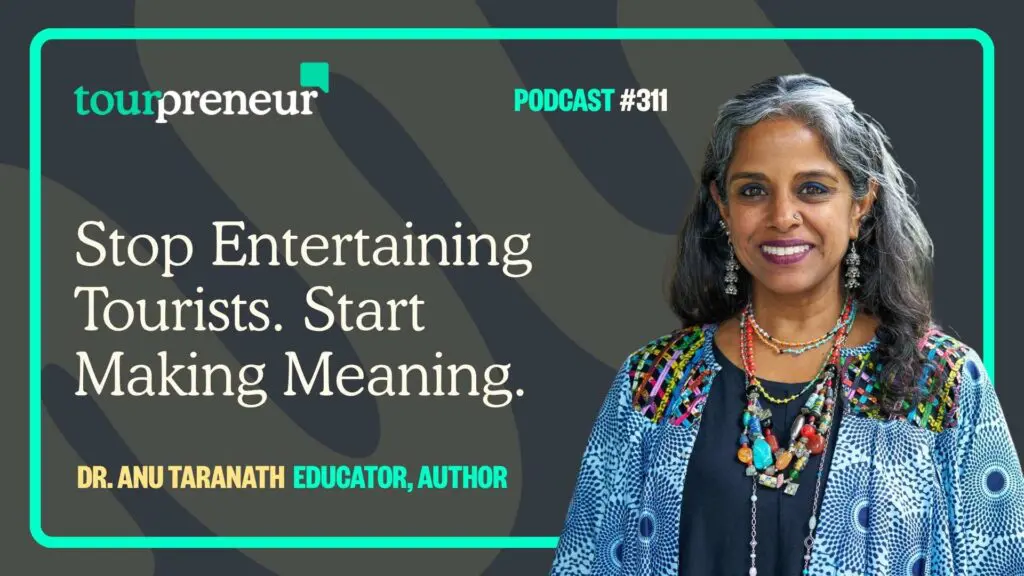
To start off 2026, Tourpreneur’s Mitch Bach speaks with Dr. Anu Taranth, a fantastic spirit and wealth of insights about the experience of travel as it occurs in a world filled with difference, inequality, but also incredible opportunities to be stretched and re-humanized.
Below you’ll find takeaways, and key topics covered.
Anu is a professor at the University of Washington, and author of Beyond Guilt Trips, a must-read book that became a breakout hit in the travel industry during Covid. She takes undergraduates on trips abroad every year, acting as a cultural bridge builder who doesn’t shy away from tough discussions of difference and comfort.
In this episode, you’ll learn:
- Why the so-called “practical” parts of guiding—logistics, timing, group control, reviews—are never separate from human behavior and emotional dynamics
- The critical difference between entertaining guests and creating meaning, and why meaning leads to deeper satisfaction and fewer friction points
- How “armor” shows up in both travelers and guides, and what it signals about fear, unfamiliarity, and unmet expectations
- A simple but radical facilitation shift—from judgment to “I notice”—that helps defuse tension and invite curiosity across difference
- Why self-awareness is a foundational business skill for guides, not a soft add-on to training
- How designing an emotional container on tour can transform group dynamics, guest behavior, and the overall quality of the experience
Six Practical Takeaways
1. Train guides on self-regulation, not just storytelling
If a guide can’t notice when they’re triggered, defensive, or rushing, it will leak into guest interactions. Add short self-awareness check-ins to guide training (“What throws you off?” “What makes you tense on tour?”). This alone can reduce guest conflict and bad reviews.
2. Design your tour pace for meaning, not density
Audit your tours for moments of constant motion and nonstop talking. Then intentionally add pauses—silent walking, open-ended questions, or unscripted observation time. These micro-spaces often create the moments guests remember most.
3. Replace opinions with noticing
Coach guides to swap “I think / People here believe…” with “I notice…” This small language shift lowers defensiveness, invites participation, and helps navigate sensitive cultural differences without lectures or moralizing.
4. Name armor instead of fighting it
When guests are demanding, skeptical, or disengaged, treat it as armor—not hostility. Reset expectations early (“Travel can feel disorienting; that’s normal”) to soften behavior before it escalates. This reframing alone can change how your team handles “difficult” guests.
5. Normalize what’s normal—out loud
Don’t avoid discomfort around bathrooms, accents, food, inequality, or unfamiliar norms. Naming what people are already noticing reduces anxiety and builds trust. Silence often creates more tension than acknowledgment.
6. Redefine professionalism for your team
Make it explicit that professionalism isn’t emotional distance or rigid control—it’s the ability to hold complexity, curiosity, and care at the same time. Operators who model this see better team cohesion and stronger guest relationships.