
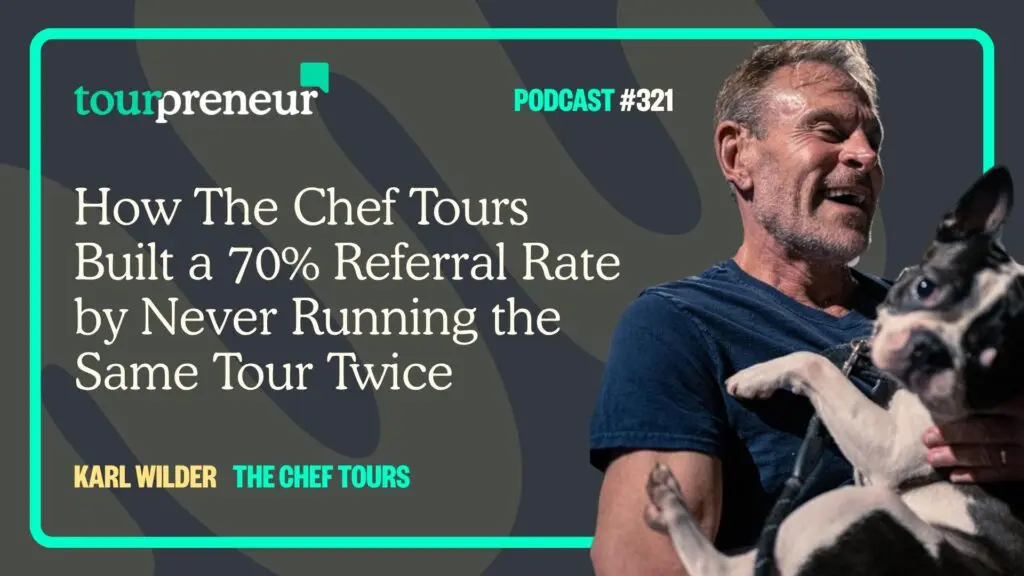
Karl Wilder started The Chef Tours with 300 euros, no advertising budget, and a radical premise: spend the majority of your ticket price on food and wine, not marketing, and let your guests do the talking. It worked: 70% of his bookings now come from referrals.
Karl spends upwards of six months developing each new city, walking streets with his dog Milou, watching how vendors cook, tasting obsessively, choosing unique neighborhoods that other operators avoid. No two tours are the same: every tour shifts based on who’s in the group, what’s in season, which stand is having a great day. Groups are capped at six. There are no scripts. Chefs — not guides — run every experience, sharing their own lives, kitchens, and relationships with the city.
In this episode, Karl and Tourpreneur host Mitch Bach dig into why this model works, how to develop tours through deep neighborhood immersion rather than clipboard research, why he’s selling a “development tour” as he explores the next city Buenos Aires, what operators get wrong about food storytelling, and why the messiest, most human, most unrepeatable experiences are the ones people can’t stop talking about.
Key Takeaways
- Spend the majority of your ticket price on the experience, not on ads. Karl spends over 50% on food and wine and gets 70% of bookings from referrals — his guests are his marketing department.
- Build your tour around an irreplaceable human, not a repeatable script. When the guide is the reason people book — their story, their relationships, their personality — you have a moat no competitor can copy.
- Spend months, not days, developing a new tour. Karl walks neighborhoods for six months, tasting obsessively, watching vendor patterns, and building relationships before ever putting a product on sale.
- Choose the neighborhoods other operators avoid. The messy, real, non-touristy parts of a city are where the most memorable and differentiated experiences live.
- Never run the same tour twice. Adjust for the group, the season, what’s available that day, and which vendors are on — the unpredictability is the product, not a flaw.
- Cap your group size and charge accordingly. Six guests means access to tiny spots, real personal connection, and the kind of intimacy that turns customers into evangelists.
- Do your own primary source research — throw away Wikipedia. Food history online is riddled with myths and manipulation; the operator who digs into library archives and old newspapers tells stories nobody else can.
- Train your guides to observe, not recite. Ask them: why does this matter to the guest, what did you miss in the square, how do pedestrians move through this space?
- Turn your R&D phase into a bookable product. Karl is selling spots on his Buenos Aires development tour at cost — guests help shape the experience and become invested advocates before the tour officially launches.
- Don’t be in love with anything, be involved with everything. Keep one or two non-negotiables that define your brand, but ruthlessly cut anything guests consistently don’t respond to — no matter how much you personally love it.