
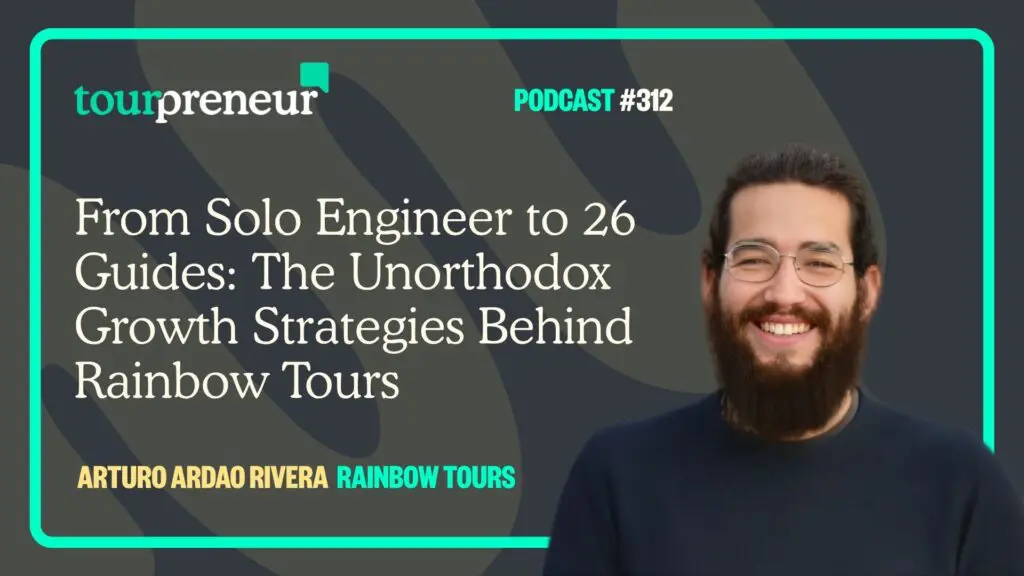
This short episode was recorded live at GetYourGuide’s Unlocked conference in September 2025.
When you meet Arturo Ardao Rivera, the first thing you feel is his energy. He doesn’t come off as an engineer, which was his profession until he discovered a joy for tour guiding and running a tour business. Originally from Madrid, Arturo found his true passion when he created Rainbow Tours Stockholm. It has grown from a solo operation to employing 26 guides.
His story is one of rejecting some of his engineering tendencies (choosing feelings over numbers!) and leaning into strategies that appear unorthodox but have worked well for him.
You’ll discover:
- His unique “taxi tariff” model for private tours, and his approach to hyper-personalization.
- Why he doesn’t ask for reviews
- Why he’s not sold on the “get more bookings” industry mantra
- Why he visits guides he’s thinking of hiring in their comfort zone, not his
- How guide applicants are asked to become undercover tour takers
- How he leverages running two separate brands for pricing strategy
- How he grow leveraging 10+ OTA partners, and how he’s managing his distribution mix
Connect with Arturo on LinkedIn and visit Rainbow Tours Stockholm
Some Takeaways from the conversation
1. “More bookings means more headache, not more profit”
Revenue isn’t just a number—it’s the effort required to generate it. A smaller operation with lower effort-per-dollar can be more profitable than a scaled-up grind. The real metric is revenue relative to your energy expenditure.
2. “You either have social energy or you don’t—history you can teach”
Arturo is blunt: the ability to read body language and connect with guests is largely innate. You can train someone on content, but you can’t manufacture presence. Hire for social energy first, train for knowledge second.
3. The “stealth candidate” hiring method
New applicants are sent undercover on existing tours—posing as regular guests—to observe guides and secretly interview customers about their booking experience. They also report back on guide performance when the guide doesn’t know they’re being evaluated. It’s a spy ring disguised as HR.
4. The “taxi tariff” model for private tours
Charge by the hour, let the guest decide when to stop. Standard tour is 2.5 hours, but guests can extend—or cut short if grandpa’s tired. Arturo regularly goes 6-8 hours because guests keep saying “let’s keep going.” Letting customers control duration signals confidence and builds trust.
5. “I do absolutely nothing to encourage reviews”
No follow-up emails, no incentives. The logic: pushed reviews are shallow (“everything was good”). Organic reviews from genuinely moved guests are the ones that actually sell. Stop optimizing for quantity. Genuine connection generates better copy than any ask.
6. 10 OTA partners, not 1 or 2
Different OTAs bring different demographics: GetYourGuide delivers Central Europe, Viator delivers US/Australia, a Spanish OTA delivers Latin America. Peter’s stat: 95% of small operators have 5 or fewer partners. Nearly all scaled operators have 10+. Distribution diversification is a growth indicator.
7. Two brands, one owner—customers don’t know
Arturo runs two separate companies: one for standard walking tours, one for high-end private tours. Customers have no idea they’re the same operation. This lets him test pricing strategies and capture different market segments without brand confusion.
8. Don’t measure health by bookings—measure by guide exhaustion
When guides say “no more shifts, I need to rest,” that’s the danger signal. Internal team sentiment is a better barometer than revenue or customer counts.
9. TikTok virality can deliver 50 direct bookings from one video
No predictability, but huge upside. One viral Northern Lights video drove 50 direct bookings. Meanwhile, Facebook? Basically useless for Arturo. Word of mouth from 40+ travelers comes from personal recommendation, not ads.
10. “Treat your guides so well they never want to leave you”
Competitors who scaled fast post-COVID burned through guides because they didn’t treat them well. Six months later, they were rebuilding from scratch. Retention is your competitive moat—not recruitment.